


For efficient operations and profitability in contemporary warehousing and international supply chain operations, the security and quality of products being moved become a priority. Conventional approaches to manual stretch wrapping become ineffective in the face of extreme weather conditions, shipping through waterways, and intense handling, causing moisture problems, dust buildup, and catastrophic load shifting. The solution to all these problems is the use of a pallet shrink wrap machine, which has become a necessity for progressive manufacturing and logistics companies. This guide delves into the different types, innovative technology, and essential factors in the purchase of such machinery.

What Are Pallet Shrink Wrap Machines?
This industrial pallet shrink wrap machine is an automatic packaging machine that has been designed to handle heavy-duty pallet loads.
In contrast to stretch wrapping, where the film is wrapped over the load through tension, in shrink wrapping, the load is covered with a specially designed plastic cover that may have a thickness of 80 to 150 microns depending on the type of application. Thermal energy is used to make the plastic cover shrink over the load. It is a five-sided covering, thus making products safe from rain, sun, dust, and corrosive chemicals.
How It Works
The operational workflow of a typical pallet shrink wrap machine follows a precise, multi-stage automated cycle designed to maximize structural integrity:
Hooding Stage
The machine automatically feeds, cuts, and opens a tubular film. Utilizing a natural air-accumulation technique—often referred to as the parachute principle—it gently and evenly drapes the plastic film over the entire pallet load from top to bottom.
Alignment & Positioning
The film hood is accurately positioned around the four sides and lower edges of the pallet, ensuring proper alignment while keeping standard forklift entry channels completely clear.
Shrink Framing Stage
A high-precision thermal frame moves vertically around the pallet, emitting controlled, uniform hot air. This thermal blast causes the film to instantly shrink, gripping the product stack tightly and creating exceptional load stability for transit.
3. Main Types of Pallet Shrink Wrap Systems
In terms of the packaging infrastructure, there are various unique types of pallet shrink wrap machines that facility managers face due to their individual needs and space limitations.
Hood Applicators in a Parachute Design
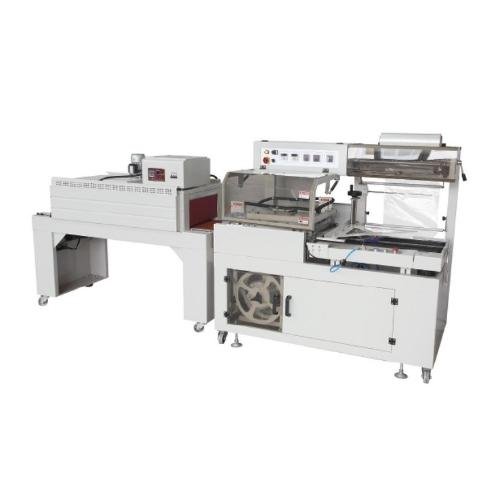
Such machines are equipped with film feeding from ground level and are therefore easy and quick to load with new rolls of film. In case you need an example of an automated material handling system used in conjunction with pallets and for continuous high-speed vertical bundling, an example would be the JOCHAMP ZWG-450 Automatic L-Sealer Machine:
- Conception compacte
- PID temperature control system: independent control of temperature with energy savings
- Multi-spray process in the body of the machine: high resistance to corrosion, easy to clean
- Hot air circulation shrinking tunnel: allows film to heat uniformly and saves energy
Flexible Multi-Format Hood Machines
The machines mentioned here automatically change and can work with up to six different formats of films or film thicknesses at a time. Such machines will be useful for operations that have a variety of products.
Film Sleeving Machines
Designed to work with variable-length items and various sizes of items to be bundled, a pallet shrink wrap machine equipped with film sleeves provides a relatively inexpensive means of packaging. For example, in operations where different bottle sizes need to be bundled, machines similar to JOCHAMP Shrink Sleeve Machines show that film sleeving can be effective in partial or complete coverage without slowing down the bundling process.

Core Technologies: Energy Conservation and Special Modules
With an increasing push towards carbon neutrality in all global sectors and significant efforts to minimize operating costs, newer versions of the pallet shrink wrap machine incorporate many engineering advancements.
Energy-Efficient Heating
Earlier versions of thermal frames required large amounts of power to run. However, more advanced models of the pallet shrink wrap machine rely on mixed-air low-temperature systems and new energy-saving technologies (such as Covershrink technology), which allow a decrease in heating energy consumption by 35%-40% without compromising the seal’s tensile strength.
Bottom Locking and Automated Integration Modules:
- Undershrink Mechanism: Through compression of the packaging film under the pallet runners, the pallet shrink wrap machine raises total shear strength by over 50%, ensuring the removal of any load movement risk during transport.
- Open Fork Pockets of the Pallet Foot: Through precise cutting of the film in the thermal contraction process, the pallet shrink wrap machine provides required space for the fork pockets, facilitating easy integration with AGVs and automated high-bay storage.
2026 Industry Uses & Buyer’s Guide
Industry Uses
Thanks to the moisture-proof and stability benefits provided by this equipment, the pallet shrink wrap machine is widely used in several highly demanding industries:
- Glass and Beverages Industry: Prevents stacked bottles or fragile packaging from falling, scratching, or becoming wet during freight transportation.
- Chemicals and Building Materials: Protects heavy bags, cement blocks, and chemical drums from rain, dust, and prolonged UV exposure in outdoor storage yards.
- Household Appliance and Paper Products: Secures delicate white goods and paper rolls from humidity and dust in the warehouse during holding time.
Buyer’s Guide: How to Choose?
Investing in the right pallet shrink wrap machine requires a thorough analysis of four core operational benchmarks outlined below:
| Evaluation Metric | Key Consideration | Recommended Standard |
| Daily Throughput | Pallets packaged per shift | Small-to-medium facilities suit semi-automatic units; high-volume lines require fully automatic hooders |
| Format Flexibility | Frequency of pallet size changes | Facilities with high SKU variations should prioritize multi-format flexible auto-switching models |
| Efficacité énergétique | Power consumption per pallet (kWh) | Select systems featuring low-temperature mixed air and thermal recovery to lower operational expenditures |
| Niveau d'automatisation | AGV and AS/RS compatibility | Ensure the selected pallet shrink wrap machine supports open pallet feet and PLC signaling integration |
Conclusion
Utilizing an energy-saving pallet shrink wrap machine that works effectively is a proven way to reduce shipping damage and save on film usage while ensuring the future safety of your automated warehouse operations.
If you have any queries or need personalized advice on technology, feel free to reach out to us at JOCHAMP anytime!