


For manufacturers that need to wrap larger cartons, the packaging machine must do more than simply accommodate a bigger product. It also needs to maintain smooth film wrapping, neat folds, and reliable sealing during continuous operation. Compared to regular-sized cartons, large cartons pose more requirements in terms of feeding, film control, and working space. Consequently, in determining whether the Envoltura is applicable for larger cartons, one has to focus on carton size, film, accuracy of wrapping, and production speed instead of only on the maximum capacity of the machine.
1. Why Is Wrapping of Larger Cartons Harder in Case of Using an Envoltura?
There are several aspects that make large cartons more difficult to wrap using the overwrapper machine. First, as the surface of the carton grows larger, the amount of film used to cover the product increases, and at the same time, the mechanism has to move accurately around the large corners and edges of the carton. In case the carton is misaligned when entering the wrapping zone, even a slight deviation may cause wrinkles, inaccurate folds, or misalignment of the seal position.
One more aspect that influences the quality of wrapping is the tension of the film. For instance, a carton sized approximately 260 × 160 × 70 mm is going to need more film during folding and sealing than a small package. In case there are problems with feeding the film, the product may become loosely wrapped, stretched, and have an uneven surface.

2. Can an Overwrapper Adapt to Larger Carton Sizes?
Yes, but this depends on the machine’s working range and mechanical configuration. An Overwrapper designed for larger cartons generally needs a sufficiently wide feeding path, adequate working space, and a folding system capable of handling the larger surface area of the package.
For a carton measuring around 260 × 160 × 70 mm, for instance, the machine needs enough clearance not only to accommodate the product but also to allow sufficient space for conveying, folding, and sealing. If the carton shifts by 3–5 mm during operation, the final wrapping appearance may also be affected, particularly when the product requires a clean and consistent package finish.
Adjustability is therefore an important consideration. Adjustable guides, conveying components, and positioning mechanisms can help the machine accommodate cartons of different sizes. For manufacturers handling multiple package formats, this flexibility can reduce the need for separate equipment and minimize downtime during format changes.
3. How Does an Overwrapper Maintain Wrapping Quality on Larger Cartons?
Accurate Film Feeding
Accurate film feeding affects the outcome of the resulting package appearance. In the case of large-sized cartons, it is required that the film be fed into the wrapping station at an appropriate speed so that there is enough material for proper folding and sealing. Too much tension may cause stretching of the film, whereas too little may result in the looseness or wrinkling of the film.
Stable Folding and Sealing
Since the size of the wrapping area increases, it is necessary to ensure that the process of folding is performed at a stable speed so that there will be clean folds of film along the edge of the carton. The sealing process also requires constant pressure, temperature, and sealing time.
Stable Positioning of the Carton
It is important that the carton remains in its correct position from feeding to the sealing process. Automatic conveying and positioning may save a lot of effort for manual alignment of the carton before wrapping. It is especially important for production lines that wrap dozens of packages within one minute.
4. How Can an Overwrapper Improve Speed and Efficiency for Larger Cartons?
Although larger cartons require more film movement and a greater working range, this does not necessarily mean that packaging efficiency must decrease. A properly configured Envoltura can integrate product feeding, film wrapping, folding, sealing, cutting, and conveying into a continuous packaging process, reducing repetitive manual operations.
For example, the Máquina para envolver varios paquetes con celofán JC-450 is designed for multiple-package and larger-carton applications. It can accommodate package sizes of approximately 260 × 160 × 70 mm and achieve production speeds of 30–70 packs/min. The machine uses servo control and integrates conveying, film folding, sealing, and other operations into a continuous wrapping process. These features help maintain consistent package quality while supporting high-volume production. For production lines that handle different package combinations, this configuration can also provide greater equipment adaptability and production flexibility.
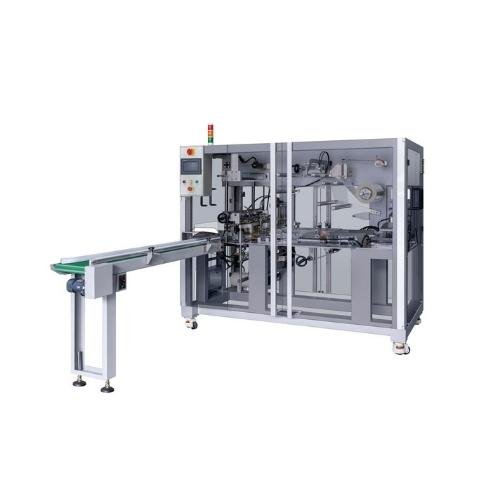
However, actual output should not be judged solely by the machine’s maximum speed. A machine that can operate steadily while minimizing downtime and adjustments may be more suitable for continuous production than one that only achieves a higher nominal speed for short periods. Actual efficiency is also influenced by carton dimensions, film characteristics, product feeding methods, and operating conditions.
| Factor | Impact on Packaging Efficiency |
| Tamaño de la caja | Determines the required working range |
| Tipo de película | Affects feeding, folding, and sealing |
| Product positioning | Influences wrapping consistency |
| Operating speed | Determines potential output |
| Changeover time | Affects flexibility for different package sizes |
Automation can also reduce repetitive manual operations. When carton feeding, film feeding, and wrapping movements are properly synchronized, operators do not need to frequently adjust individual packages. For manufacturers that continuously process larger cartons, this can improve production efficiency while maintaining more consistent wrapping quality.
5.Conclusion
Overall, an Overwrapper can efficiently handle larger cartons when its working dimensions, film system, conveying mechanism, and production capacity are properly matched to the actual packaging requirements. For manufacturers, choosing the right machine should not be based solely on maximum speed. Carton dimensions, wrapping accuracy, film compatibility, and the required production cycle should also be taken into account.
If you are looking for packaging equipment for larger cartons or multiple-package applications, or if you have any questions about an Overwrapper, feel free to contacto Jochamp for more information.